Understanding the options available to the audience is key to strategizing a plan to get their attention.
Brands that simply offer more of the same are only successful in blending in and contributing to market noise.
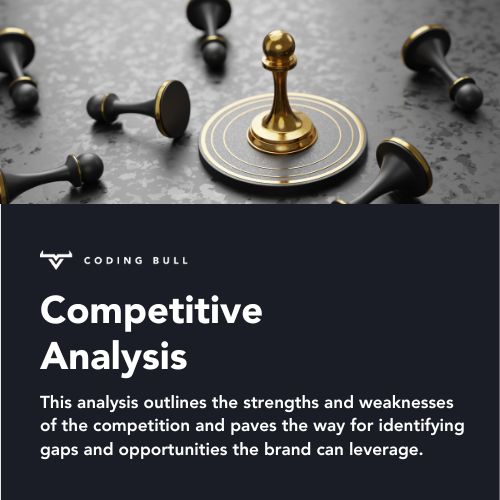
A competitive analysis outlines the strengths and weaknesses of the competition and paves the way for identifying gaps and opportunities the brand can leverage.
Comprehensive competitive analysis provides brand builders the information needed to make strategic decisions by answering critical questions such as:
- What opportunities exist?
- What are the gaps?
- How do we fill the gaps?
- What are the market trends?
- What features should we focus on?
- What benefits do we promote?
- How does our audience feel?
- Where is our audience being let down?
- How can we stand apart from our competitors?
Without an effective competitive analysis, the answers to these questions would be based on a guess at best.
Competitive analysis provides the information needed to make strategic positioning decisions.
It’s a critical step in mapping the market landscape and uncovers information such as:
- Similarities
- Differences
- Strengths
- Weaknesses
- Audience Preferences
- Offers
- Customer Sentiment
- Features
- Benefits
- Value
- Price Points
- Differentiators
- Market Positions
Scope of Work
Competitive Analysis - Scope Of Work
For example, if you’re opening a trendy book café, then the McDonald’s down the road is less relevant than the hipster café around the corner. Start with a search on Google for what you do and capture the top 10 results remembering your relevancy focus. If the results page is full of multinationals and you’re a small start-up, then you need to get more specific with your search to identify more relevant competitors. You can also use social media channels such as Facebook, Linkedin and Youtube by typing in keywords or relevant hashtags. Then there’s the keyword research route. Identify the highly relevant keywords your target audience searches for around what your brand does and use a tool such as SEM Rush to drill down into the brands ranking for those keywords. Whichever method you choose, identifying the most relevant competitors is the critical starting point.
Next you want to categorise your competitors from one of the following choices:
Primary Competition
These are your most relevant direct competitors. You’ll share the same audience and will have similar or the same products or services.Secondary Competition
These are the competitors who serve your audience with a lower or higher end version of what you offer. They’re fixing the same problem but often for different people through a different experience.Tertiary Competition
These are indirect competitors though you play in the same space. They might have slightly different customers and offer a slightly different solution, though there is crossover in what you do and could serve as an alternative. Although it’s important to have an understanding of the broad landscape, focus on relevancy. You’re top 10 most relevant competitors may all be your primary competition. Always ask the question when comparing competitors:“Who would my audience most likely use?”
This is where you put on your fake moustache and go undercover to become the customer. You want, with your consumer hat on, to experience each of the brands in your top 10 list as your customers would experience them. Each of your competitors will have multiple touch points. Make it your business to find and experience each one.
The first experience you will likely have with your competitors is their visual brand. If it’s designed well, this should be making a strategically intended impact and it should also communicate specific characteristics. Analyse the look and feel of the brand and the moods or feelings it evokes. Analyse the overall user experience of the website and how the content is presented visually. Aside from digital, is there any physical branded material you can get your hands on such as brochures or flyers? (this is relatively easy if your competitors have physical locations). How do they use
- Colour
- Typography
- Images
- Supporting Visuals [icons, graphics or patterns]
As you read through the material on you competitors’ websites, pay close attention to the messaging. Throughout their website, their physical branded material and their social channels, you will have enough to be able to identify themes. The themes are the repeated messages, which communicate what the brand wants the audience to understand and associate with them which may include key benefits, descriptors of the target audience and differentiators. Also study the way in which they deliver the messaging.
Have any of your competitors adopted a human brand persona to deliver their message? Can you identify a core archetype you would align to how the brand communicates? Are there specific characteristics on display through the visual brand or the messaging? What language is being used by the brand? Are they overly corporate or do they use informal conversational language or even slang? What about their tone-of-voice? Are they serious, witty, professional, playful, caring or gritty? How would you describe the tone-of-voice they’re using and is it aligned with the visual brand and the messaging?
What kind of content are your competitors producing? Do they have a blog? Do they have a Youtube channels? Are they helping their audience with useful techniques? What about their social channels? What are they posting or sharing? Are they simply trying to generate likes or are they engaging their audience with stimulating conversations and helpful insights?
How are your competitors marketing their products or services? Are they advertising? If so, where are the advertising and what are they offering? Are they giving away free content in the form of a lead magnet on their website (E.g. an free eBook or a free template etc. in exchange for your email). If they are, sign up with their opt-in form and analyse the emails that come through. If a series of emails come through over the following days, you’ll likely be on an automated email sequence, which will eventually lead to an email with some kind of offer. Take every “Call-to-action” they offer you and analyse where it takes you and what messages are delivered to you.
Throughout their content, their marketing and their overall presence, your competitors should be making offers to their audience to become a customer in some way shape or form. What are these offers and how are they structured? Do they offer a free trial or a low-cost entry subscription? Do they offer discounts off the first product or service or do they simply tell their audience why they are the brand of choice?
From everything you experience from the brand you’re analysing, there will be an underlying message and theme throughout. This theme is constantly attempting to position the brand in the mind of the audience based on a very specific differentiator. If the brand has an efficient communication strategy, it should be easy to identify the difference the difference and the big idea they have built the brand around. Though they won’t communicate specifically what their positioning strategy is throughout their messaging, they should be communicating clearly, exactly why the audience should be choosing them. This is their differentiator and is more than likely the reason their customers have chosen them as their choice of brand. If you can’t easily identify your competitors’ differentiators, it’s not your fault; it’s theirs. If you can’t find it by looking for it, your shared audience won’t see it either.